
How to Choose the Right Air Duct Cleaning Company in Cathedral City
The short answer: ask what equipment they’re bringing before you ask about price. A company running a contractor-grade negative-air system with real CFM behind it will outperform a discount operator with a rebranded shop vac every single time, regardless of what their Google rating says. If you’d rather not spend your afternoon vetting duct cleaners, call us at (866) 968-5699 and we’ll walk you through exactly what we use and why.
Listen, this isn’t a category where all providers are created equal. Not even close. We’ve spent enough years pulling dead rodents, drywall dust, and three decades of accumulated lint out of Cathedral City ductwork to know the difference between a real clean and a theatrical one. And the difference almost always comes down to what’s on the truck.
The Question That Exposes Every Pretender
Before you book anyone, call and ask one question: “What’s the CFM rating of your collection vacuum?”
Here’s why this matters. CFM stands for cubic feet per minute. It measures how much air the vacuum system actually moves. A consumer-grade shop vac might pull 100 to 150 CFM. That’s fine for cleaning up sawdust in a garage. But your ductwork runs through walls, floors, and ceilings. The runs are long. The debris is caked onto duct walls after years of air pushing past it. A 150 CFM machine simply cannot create the negative pressure needed to pull that material out of the system.
Contractor-grade equipment, like the Rotobrush and Nikro systems we run, moves air in a completely different league. These are the same machines you’ll find on commercial jobs and remediation sites. They create genuine negative pressure through the entire duct system, which means debris gets pulled toward the collection point rather than just loosened and left to resettle. If the person on the phone can’t answer the CFM question, or tries to change the subject to price, you’ve learned something important about how they work.
In Cathedral City specifically, this matters even more than it might elsewhere. Our dry desert climate means ducts fill with a particular kind of fine particulate: decomposed granite dust, construction debris from all the infill development, and the fine silt that blows in off the open desert on windy days. That material is light enough to become airborne but heavy enough to settle deep in duct runs. A weak vacuum doesn’t stand a chance against it.
Three Equipment Benchmarks That Actually Predict Results
Most companies will show you a badge, a van wrap, and a coupon. Here are the three equipment benchmarks that tell you whether the clean will actually work.
1. Vacuum CFM Capacity
We covered this above, but it bears repeating because it’s the single most predictive factor. Contractor-grade systems start around 1,500 CFM and go up from there. Anything below that is a consumer machine doing a consumer job, no matter what the brochure says. Ask for the number. A real duct specialist will know it off the top of their head.
2. Agitation Method
The vacuum does the pulling. Something has to do the loosening. The three common methods are rotary brush, air whip, and skipper ball. A skipper ball is a foam ball on a string that gets pushed through the duct. It’s the cheapest method and it mostly just bounces around. An air whip uses compressed air to blast debris loose, which works okay in round metal ducts but struggles in flex duct and rectangular trunk lines.
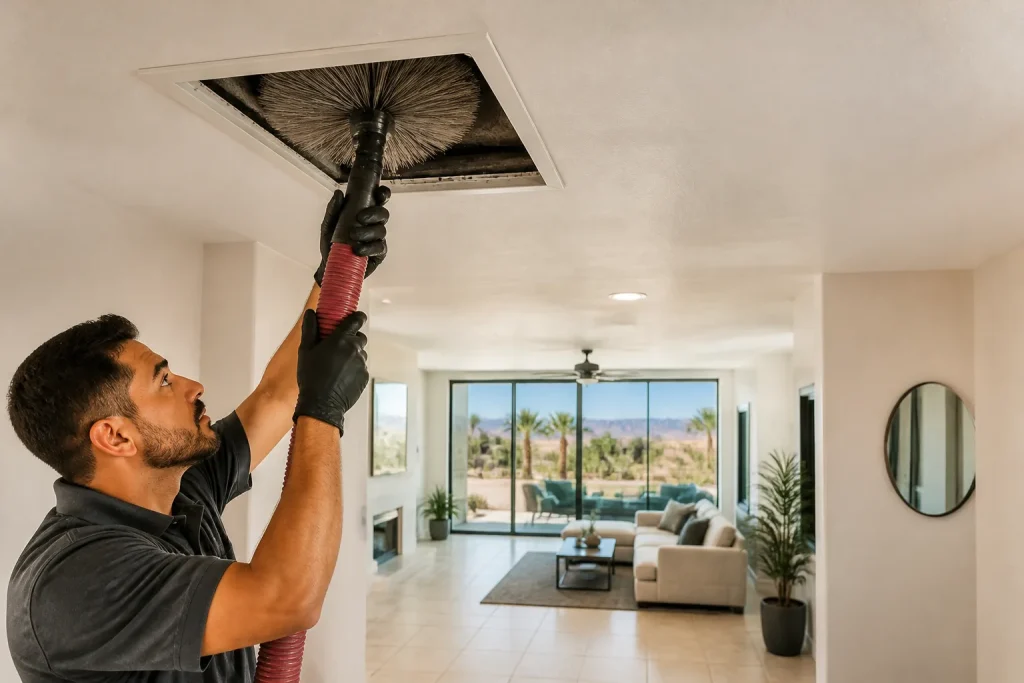
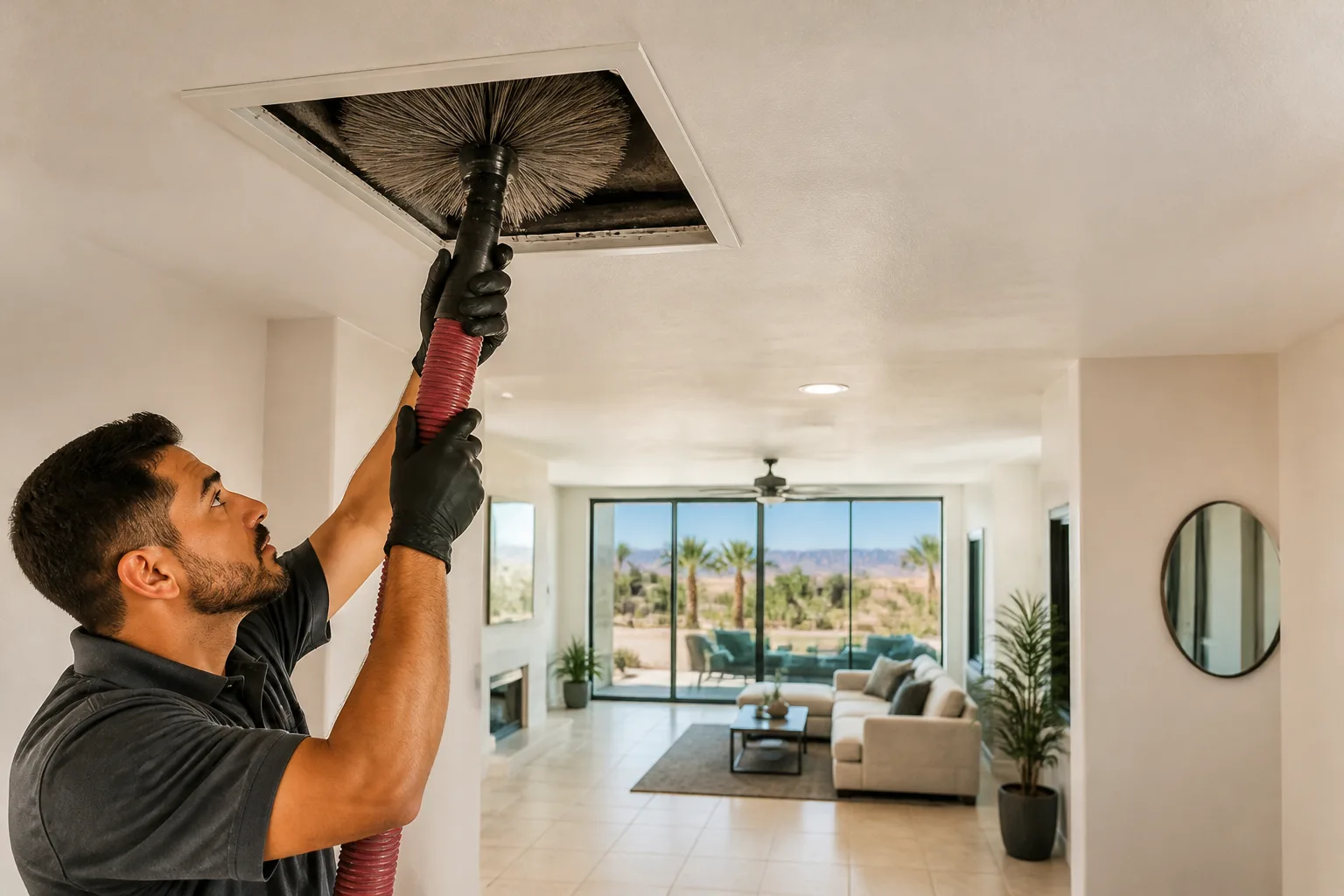
A rotary brush system, driven by a motorized cable, physically scrubs the duct walls. This is the method used on remediation-grade jobs, because it actually removes the biofilm and caked dust rather than just knocking the loose stuff free. In Cathedral City, where many homes have a mix of rigid trunk lines and flex duct branches, the brush makes a measurable difference in what comes out.
3. Negative Pressure Verification
A legitimate contractor should be able to explain how they verify negative pressure during the job. That means confirming the system is actually pulling air from every register, not just the ones closest to the vacuum connection. We check this at every access point before we start cleaning. If a company can’t explain what negative pressure verification looks like on your specific system, they’re probably not doing it.
Why a Duct Specialist Beats an HVAC Generalist
Here’s a scenario we see regularly in Cathedral City. A homeowner calls an HVAC company because the furnace kicked on and they smelled something musty. The company sends a technician who’s great at compressors and refrigerant lines. While he’s there, he offers to “clean the ducts” as an add-on. He runs a brush through a few registers, vacuums out what he can reach, and charges a few hundred dollars for the privilege.
The problem? He’s a generalist doing duct work as a side hustle. His company’s revenue comes from equipment installs and repairs. Duct cleaning is a revenue line they bolt on when a technician has spare time on a call. That technician has probably never seen the inside of a duct system the way a full-time duct specialist has.
When you’re comparing companies online, you can usually spot the generalist pretty quickly. Their website leads with HVAC installation, AC repair, furnace tune-ups. Duct cleaning appears as a bullet point somewhere on a services page. A dedicated duct specialist leads with the ducts. Their entire service menu is built around what’s in your walls and ceilings, not the equipment that blows air through them.
Our company does three things: air duct cleaning, dryer vent cleaning, and air duct repair. That’s the whole list. Every technician we send out does this work all day, every day. That focus matters when we’re on a ladder in your attic looking at a flex duct that’s collapsed in the middle.
The Five Questions to Ask Before You Book Anyone
Here’s the vetting script we’d recommend to a friend in Cathedral City. Five questions, with the answers that should raise a red flag.
- “What CFM does your vacuum system pull?” A real answer is a number at or above 1,500 CFM. A red flag is hesitation, or “well, it’s a powerful vacuum.”
- “What’s your agitation method?” You want to hear “rotary brush” or “agitation tool driven by the system.” If they say “skipper ball” or don’t seem to know what you’re asking, keep looking.
- “Do you do a pre-work inspection and what does it include?” The right answer involves accessing the duct system, visually inspecting the interior, checking for damage, and identifying material types before any cleaning starts. The wrong answer is “we just show up and clean.”
- “What happens if you find damaged ductwork?” A cleaning-only company will say they’ll note it and move on. A full-service duct specialist, like ours, can repair the damage in the same visit. We clean it, and if we find damage, we fix it.
- “Can I see the before and after photos?” Any legitimate company should be willing to show you what your ducts looked like before and after the clean. If they balk at that, they’re hiding something about their process.
What a Legitimate Pre-Work Inspection Looks Like
Here’s where a lot of Cathedral City homeowners get shortchanged. A company shows up, sets up a machine, starts running lines, and nobody ever actually looks inside the ducts before the cleaning begins. That’s a problem, because duct systems in this area vary enormously.
Some homes have rigid sheet metal trunk lines with fiberglass board plenums. Others have all flex duct, which responds completely differently to agitation. Mobile homes and older ranches in the northern part of Cathedral City often have systems that were installed decades ago, with materials that are brittle and fragile. A proper pre-work inspection identifies the duct material, checks for existing damage, locates all access points, and maps the system layout before any equipment gets turned on.
We also use a camera to visually inspect the interior of the main trunk lines. You can’t trust a cleaning on faith. You should be able to see what’s actually in your system before the work starts, and then see it again after. That’s the transparency standard any legit operator should meet. It’s also why we use Abatement Technologies equipment on jobs that require HEPA-filtered containment and negative air pressure. Some dust in Cathedral City homes contains more than just dirt – we’ve seen systems with significant construction debris, pest waste, and material from old renovations. When a system calls for it, the right equipment makes all the difference.
If the company you’re considering doesn’t mention an inspection phase, ask what they plan to do first. If the answer is “start cleaning,” find someone else.
Cathedral City-Specific Vetting That Actually Applies
Here’s the stuff that matters in this specific market. When you’re comparing duct cleaners in Cathedral City, keep these local factors in mind.
Licensing. In California, duct cleaning does not require a specific contractor’s license on its own the way HVAC installation does. That means some operators are working without any meaningful oversight. A C-61 / D-34 license (the specialty classification for insulation and duct work) is a strong signal that the company operates legitimately and carries the insurance that comes with it. Don’t be afraid to ask.
Service area. Cathedral City is one of the smaller cities in the Coachella Valley, but local duct cleaners often serve the whole valley. When you’re reading reviews, pay attention to whether the company actually works in Cathedral City specifically. Neighborhoods like Panorama, Rio Vista, and the Cove have different housing stock than what you’ll find in Rancho Mirage or Palm Desert, and the dust profile is different too. A company that’s actually familiar with the homes here will know what to expect when they open up a system in a 1980s tract home versus a newer build in the northern section of the city.
Reviews that mention specifics. Skip the five-star reviews that say “great job.” Look for reviews that mention equipment, process, or specific outcomes. A review that says “they showed me the before and after photos and explained the CFM rating of their system” tells you far more about the actual work than a string of “friendly tech, quick service” comments. That’s true in any market, but in Cathedral City’s competitive duct cleaning space, it’s a particularly reliable filter.
The Bottom Line
The duct cleaning industry has always had a bait-and-switch problem. Low coupon prices, weak equipment, and technicians who count a job as done when the homeowner signs the invoice. Choosing the right company in Cathedral City means filtering for the things that actually predict results: the equipment on the truck, the inspection before the clean, and the willingness to show you exactly what came out of your ducts.
If you’re in Cathedral City and want to skip the vetting process entirely, Duct Cleaning Cathedral City runs contractor-grade Rotobrush and Nikro equipment, inspects before we clean, and repairs damage we find in the same visit. Call (866) 968-5699 for a free estimate.
Frequently Asked Questions
Air duct cleaning in Cathedral City typically runs between $450 and $900 for a whole system, depending on the size of the home, the number of duct runs, and the condition of the system. Beware of any quote under $300. At that price point, the company is either running weak equipment, skipping the inspection, or planning to upsell you aggressively once they’re in the door. Call (866) 968-5699 for an exact quote on your system. Estimates are free.
Because the equipment is cheaper, the process is shorter, and sometimes the job isn’t actually done. A discount operator running a portable vacuum with low CFM can offer a much lower price because their overhead is nearly nothing. But you’re paying for a process that won’t remove the debris that actually matters. The ducts will look cleaner at the register opening and still be coated with years of dust deeper in the system.
Demand before and after photos of the interior of your duct runs, not just the registers. Any company using a camera inspection before cleaning can show you the same views afterward. If they refuse or only show you a pile of debris on a tarp, you have no way to verify what was actually removed from the system versus what was simply dislodged and left behind.
In Cathedral City’s desert climate, most homes benefit from duct cleaning every three to five years. The fine dust that blows through the valley accumulates faster than you might expect, and it works its way into every part of the system. Homes with pets, recent renovations, or residents with allergies or respiratory conditions should lean toward the shorter end of that range. A dryer vent, by contrast, should be cleaned every year. Call (866) 968-5699 if you’re not sure whether your system is due.
Written by the team at Duct Cleaning Cathedral City, serving Cathedral City since 2012.
Need Air Duct Cleaning Help?
Call Duct Cleaning Cathedral City - licensed & insured, with free written estimates in Cathedral City.
(866) 968-5699